Writer
You have always been capable of more than you give yourself credit for. Whether you are rebuilding after a tough season, stepping into a leadership role for the first time, or simply tired of playing small, one thing is clear: you are ready for something different.
That is where self improvement comes in. Not the overwhelming, overhaul-your-entire-life kind, but the kind that feels personal, practical, and actually doable. The kind that meets you exactly where you are and helps you grow from that spot.
This post is for women who are done waiting for the “right time” and ready to start showing up for themselves in small but meaningful ways. You do not need a life coach, a Pinterest-perfect morning routine, or years of therapy to begin. You just need a few solid principles to guide you forward.
In this list, we are breaking down some of the most powerful self improvement principles designed specifically for women who lead with heart, rise through hard times, and refuse to make themselves smaller for anyone. Let’s get into it.
Redefine What Growth Actually Means for You
Most conversations about self-improvement start in the same place: your productivity, your output, your next promotion. And honestly, that makes sense. The dominant narrative has always framed growth as a performance problem to solve. But something significant is shifting. Researchers, market analysts, and women themselves are collectively pushing back on that model, and the data backs it up. The personal development market is projected to grow from USD 54.22 billion in 2026 to over USD 80 billion by 2034, and the fastest-growing focus area within that market is not skills training. It is self-awareness. People are no longer just asking what they can do better. They are asking who they are becoming, and that is a fundamentally different question.
For women specifically, the cost of staying locked in performance-only growth is not abstract. It shows up as burnout, as identity erosion, and as that quiet, hard-to-name resentment of becoming really, really good at a version of yourself you never consciously chose. You hit the milestones. You check the boxes. And somewhere along the way, you realize the roadmap you have been following was not actually yours. Research confirms this pattern: women navigating ambition, caregiving, and leadership simultaneously face outsized pressure to optimize externally while their inner sense of self quietly frays. Growth that ignores that reality is not growth. It is just a more sophisticated form of burnout.
A more honest model of self-improvement integrates four dimensions together: professional capability, relational intelligence, physical and emotional well-being, and identity clarity. These are not separate tracks to manage in parallel. They inform each other constantly. Strong relational intelligence makes you a better leader. Identity clarity makes your professional decisions more sustainable. Well-being is not a reward for performing well; it is the foundation that makes performance possible at all.
Here is a practical place to start: write your own growth definition. Not a goals list. One paragraph, written specifically for this season of your life, that names what flourishing actually looks and feels like for you. Include what you want to grow toward, what you want to protect, and what you are ready to release. That paragraph becomes your filter for every self-improvement resource, habit, or opportunity you encounter going forward.
Build Executive Presence on Your Own Terms
If you have ever walked into a room and felt like you had to immediately prove you belonged there, you already understand the problem with how executive presence has traditionally been defined. The standard corporate version of this skill was built around a very specific template: gravitas, dominance, a certain kind of booming confidence. And that template was not built with women in mind.
Research from the Center for Talent Innovation found that executive presence accounts for 26% of what it takes to get promoted, making it one of the highest-leverage skills you can develop. But here is the catch: women navigating this space face a structural double bind. Too assertive, and you get labeled difficult. Too collaborative, and suddenly you “lack authority.” That is not a you problem. That is a design problem with the framework itself.
What Women-Centered Executive Presence Actually Looks Like
The good news is that authentic executive presence for women is not about code-switching or performing a version of leadership that feels foreign to you. According to a step-by-step guide for women on building executive presence, genuine authority comes from being grounded in your own values, not from imitating a style that was never designed for you. This reframe matters because it shifts the work from imitation to excavation: you are not building a persona, you are developing a more intentional version of yourself.
There are three specific components worth focusing on. Vocal authority is about how you show up in rooms where decisions are made: leading with your conclusion, eliminating over-qualifying phrases, and using the strategic pause instead of rushing to fill silence. Physical groundedness is about how you hold yourself under pressure. Your body communicates before you speak a single word, and slower breath, open posture, and deliberate movement all signal confidence to both the room and your own nervous system. Narrative ownership is how you frame your expertise without apologizing for it, hedging unnecessarily, or shrinking your accomplishments into something more “palatable.” As Texas McCombs MBA faculty note, executive presence validates your expertise in rooms where bias may already be questioning it.
Commanding a room consistently ranks among the most-requested leadership development skills heading into 2026, and it is exactly the kind of growth area where generic training falls short. MotivatHER’s corporate training programs approach this through an identity-rooted lens, meaning the development work is connected to who you actually are, not just the role you are performing.
The women most often described as having presence are not the loudest voices in the room. They are the most intentional. They know when to speak, how to hold space, and how to make their ideas land. That level of intentionality is not a personality trait you either have or do not have; it is a trainable skill. And it is one worth adding to your self-improvement list this year.
Practice Non-Reactive Leadership and Understand Why It Is Harder as a Woman
Non-reactive communication is officially one of the top five personal growth trends heading into 2026, and for good reason. The ability to stay grounded and intentional under pressure, rather than responding from a place of emotion or urgency, is increasingly recognized as a cornerstone of effective leadership. Most of the conversation around this skill treats it as universal, applicable to anyone who wants to communicate more thoughtfully at work. That framing is well-meaning, but it leaves out something important: the cost of reactivity is not the same for everyone.
Here is what the gender-neutral version of this trend consistently fails to address. Research published in the Journal of Applied Psychology found that when Black women express anger in professional settings, it is far more likely to be interpreted as a personality flaw than as a reasonable response to a situation, a penalty that is not comparably applied to men. A Harvard Business Review study found that women actually report higher anxiety levels than men yet are less likely to let their emotions negatively affect their leadership performance. As research on gendered emotional labor in leadership confirms, women in positions of power also face stronger external pressure to regulate their emotions on behalf of others, making the baseline demand significantly heavier before a single high-stakes conversation even begins.
And then there is the stereotype itself. Research from Schulich School of Business challenges the persistent assumption that women are “too emotional to lead,” with Associate Professor Winny Shen’s findings suggesting it is actually men who are more likely to let emotions drive their behavior. Yet women continue to carry the reputational burden of that stereotype in rooms where it counts. That is the double bind: regulated enough to be taken seriously, but not so composed that you are seen as cold or unapproachable.
This is why non-reactive leadership for women is not simply a communication upgrade. It is a survival strategy and a genuine form of self-advocacy. Studies on emotional labor in the workplace document how women managers are disproportionately expected to perform “surface acting,” masking authentic emotions to conform to gendered workplace norms, a pattern that creates a distinct and compounding burnout risk. Add the emotional labor many women carry at home, and the regulation required for non-reactive leadership is not a neutral baseline skill. It is an additional ask layered on top of an already significant load.
So what does practicing this actually look like? A few tools worth building into your routine:
- Somatic grounding before high-stakes conversations. Before a difficult meeting or a review you are dreading, take two minutes to do a body scan, slow your breathing, and plant your feet flat on the floor. This is not about suppressing what you feel; it is about creating enough space between stimulus and response so that you lead the conversation rather than react to it.
- Pre-scripted language for interruptions and dismissal. Prepare phrases in advance so you are not improvising when someone talks over you or redirects your idea. Simple, calm redirects like “I would like to finish my thought” or “I want to come back to the point I was making” keep you grounded without escalating the moment.
- A pause protocol for triggering feedback. When you receive feedback that feels unfair or activating, give yourself permission to say “Thank you, I want to sit with this before I respond.” That pause is not weakness; it is strategy.
This particular intersection of self-improvement and gendered leadership experience remains one of the most underserved spaces in personal development content today. MotivatHER is uniquely positioned to fill it, not just as a talking point, but as a fully developed coaching and e-course framework that finally speaks to the whole picture of what it costs a woman to lead with composure and what it takes to sustain it.
Pursue Efficiency Without Sacrificing Yourself
Here is something the productivity world is finally admitting out loud in 2026: high performance and self-destruction are not the same thing, and they never were. Efficiency without burnout has emerged as one of the dominant personal growth skill areas this year, reflecting a collective reckoning with how long we have treated exhaustion as evidence of commitment. If you have been grinding through your weeks and wondering why the results never quite match the effort, this is the reframe you have been waiting for.
For ambitious women, this tension runs especially deep. Many of us were socialized to tie our worth directly to our output, which means rest can feel like laziness, slowing down can feel like falling behind, and saying no can feel like letting everyone down. Coach Laura Schwieterman puts it this way: burnout is not just about workload. It is about being disconnected from yourself for too long, performing your life instead of actually living it. That description will land differently for some women than any productivity tip ever could.
Sustainable Momentum Looks Different Than You Think
The shift happening in 2026 is not a call to work less. It is a call to work smarter in a very literal sense. Research confirms that focused work cycles can increase efficiency by up to 40%, and reducing interruptions can improve work quality by over 30%. The real opportunity is not adding more hours; it is protecting the hours you already have. Sustainable momentum is built through systems, boundaries, and energy management practices that let you operate at your actual best, not your maximum possible output. Those are very different ceilings.
Well-being is now formally integrated into professional development frameworks in 2026, not siloed into a separate wellness category you visit when things get bad. Nervous system regulation, quality sleep, and mental clarity are being talked about in the same conversation as leadership performance, because they directly affect it. This is not soft. This is strategy.
The MotivatHER podcast is a practical entry point if you are building this kind of sustainable momentum and finding that generic productivity content misses the mark. Episodes speak directly to the intersection of ambition and well-being that most self-improvement spaces do not even acknowledge exists.
Your Starting Point: The Weekly Audit
Here is something actionable you can do this week. Look at your current schedule and identify the three tasks or commitments draining the most energy without producing proportionate results. Then name one structural change that would address each one. Maybe it is a recurring meeting that could be an email. Maybe it is saying yes to things that belong to someone else. Maybe it is skipping the recovery time that actually makes everything else possible. This is not about doing less. It is about doing what matters, on purpose, which is exactly what efficiency looks like when it is working.
Develop Influence Without Formal Authority
Here is something that does not get said nearly enough: you do not need a title to lead. You never did. The ability to move people, shape culture, and drive real outcomes without relying on positional power is one of the most in-demand skills in corporate leadership development right now, and it is showing up on training request lists across industries in 2026. According to research on what professionals need heading into 2026, successful leaders are no longer defined by authority or years of experience but by adaptability, communication, and the ability to help people move forward through change. That is influence. And you can build it starting today, from wherever you are.
Why This Skill Matters More for Women
For women, this is not just a nice-to-have skill. It is often a survival strategy. Women are more likely to spend longer stretches of their careers in roles where they carry significant responsibility without the positional power to match. Advancement gaps and sponsorship disparities are well documented, and the reality is that waiting for a title before stepping into leadership is a luxury the system rarely extends equally. When sponsorship is uneven and stretch opportunities are not distributed fairly, earned influence becomes one of the most powerful independent levers a woman has. Building it intentionally is not a workaround; it is a smart, strategic move.
The Three Levers You Need to Build Right Now
Cross-functional influence is built through three specific levers, and understanding all three changes how you show up at work.
Relational credibility is about earning trust across teams and stakeholders, not just with your direct manager. It means investing in relationships before you need something from them, advocating for others visibly, and showing up as someone people can count on.
Strategic visibility is about being known for the right things by the right people. This is not about self-promotion for its own sake. It is intentional presence, the kind that comes from listening actively, contributing meaningfully, and consistently connecting your work to what the organization actually cares about.
Narrative framing is where many women hold back, and it is arguably the most powerful lever. It means being able to articulate clearly what problem you solve, why your perspective matters, and how your work connects to priorities others are already invested in. Leaders who do this with confidence build authority that sticks.
Influence Is Not Manipulation
One more thing worth naming directly: influence is not manipulation, and it is not being political or pushy. It is communication in service of a shared goal. It is collaboration. It is saying, “here is what I see and here is why it matters to all of us.” That reframe matters because many women hesitate to build influence skills out of fear of being perceived negatively. Do not let that hesitation cost you. This is one of the most transferable leadership skills you can develop, and it applies regardless of your current level or title.
For organizations ready to develop this capability intentionally in their women employees, the business case is clear. DDI’s leadership research documents that leadership development programs generate 424% ROI when implemented at the organizational level. MotivatHER’s corporate training programs are designed to build exactly this kind of capability, equipping women to lead with credibility, visibility, and voice no matter where they sit in the org chart.
Use Microlearning During Transitions, Not Just for Skill-Stacking
Microlearning, which means bite-sized, focused learning delivered in short bursts of ten minutes or less, is one of the most confirmed personal development trends heading into 2026. According to research on microlearning trends in 2026, 68% of organizations now use microlearning as their primary training approach, up from 54% just two years ago. The reason for this shift is not novelty. It is alignment with how memory actually works. Short, repeated learning beats long, intensive sessions every single time when it comes to retention. And for women who are already managing full lives, the format is not just preferable; it is often the only realistic option.
The Moment When You Need Growth the Most Is Also the Moment You Have the Least Bandwidth
Here is the part that almost no one talks about. The most important applications of microlearning are not during stable, steady seasons of life. They are during transitions. Returning from maternity leave. Pivoting to a new career. Stepping into your first leadership role. Navigating reinvention after a major life shift. These are the moments when your growth needs are genuinely at their highest, and also, quite honestly, when your available time and energy are at their lowest. Research consistently shows that more than half of employees say high workloads leave little room for learning even when they know they need it. That tension is not a personal failure. It is a structural reality, and it is exactly why the format you choose for your growth during a transition actually matters.
Identity Navigation Is Not the Same as Skill Acquisition
Most microlearning content available today is built for steady-state skill-building. It assumes you already know who you are and simply need to add new capabilities on top of that foundation. What it almost never addresses is the internal work of figuring out who you are in a completely new chapter. That is a different kind of learning entirely. It is less about what you need to know and more about how you see yourself, what you value in this new role, and what kind of leader or woman you are becoming right now. This is where MotivatHER’s approach genuinely fills a gap that generic content leaves wide open.
Practical Formats That Actually Work During a Transition
Effective microlearning during a transition does not require a complicated system. A 10-minute podcast episode that ends with one concrete takeaway you can act on today. A single-concept e-course module that builds progressively, so you are never overwhelmed but always moving forward. A weekly reflection prompt tied specifically to the transition you are currently navigating, not where you were six months ago and not where you hope to be in five years. These formats work because they match both your cognitive capacity during a high-stress season and the identity-level questions that transitions naturally raise.
Here is the most actionable thing you can take from this section. If you are currently in any kind of transition, commit to one microlearning input per week that speaks directly to this season of your life. Not content designed for a version of you that no longer exists. Not aspirational content for a future self you have not yet become. One input, grounded in right now. That single habit, practiced consistently, compounds into real clarity and real momentum over time.
Protect Your Identity Through Every Season of Reinvention
Let’s be honest about something the self-improvement world rarely says out loud: you are not the same person you were five years ago, and you will not be the same person five years from now. That is not a problem to solve. That is evidence that you are living.
Reinvention is not a crisis. For women navigating motherhood, career pivots, leadership promotions, or significant personal loss, identity will shift. The real question is whether that shift happens to you or because of you. Intentional reinvention looks like choosing what you carry forward and what you leave behind. Unintentional reinvention looks like waking up one day feeling like a stranger in your own life, unsure how you got there or what you actually want next.
Here is where the mainstream self-improvement industry quietly fails women. Most programs focus on skill acquisition and habit formation, which are genuinely useful, but they treat identity as a fixed backdrop rather than an active part of growth. Research published in the Journal of Coaching confirms that identity work during career transitions is more complex for women than traditional frameworks account for, and that coaches themselves are often underprepared for what their clients experience at this level. The result is that women can build impressive new capabilities and still revert to old patterns, not because they lack discipline, but because their internal identity has not been updated to match their external growth.
Think of it this way: you cannot sustain a new version of yourself if you are still running on the operating system of who you used to be.
Identity-rooted self-improvement asks three specific questions at every stage of reinvention, and these questions are worth sitting with seriously:
- What do I still want to be true about me? This anchors you to the values and qualities that are not negotiable, even as everything else shifts.
- What am I ready to release? This creates permission to let go of identities, roles, or beliefs that served a previous season but are now holding you back.
- What does this next version of me actually need? This moves growth from reactive to intentional, giving you a foundation for every decision ahead.
This is exactly the work MotivatHER was built for. The coaching, books, and speaking engagements are all designed around one central conviction: sustainable growth happens from the inside out. Not from chasing who the market says you should become, but from getting deeply clear on who you already are and choosing, with intention, who you are becoming next.
The women who navigate reinvention most successfully are not the ones who change the most. They are the ones who stay most connected to their core values while everything around them is in motion. Clarity of identity is not a luxury for when life slows down. It is the anchor that makes it possible to keep moving forward when it does not.
Evaluate Your Growth Investments Like a CEO
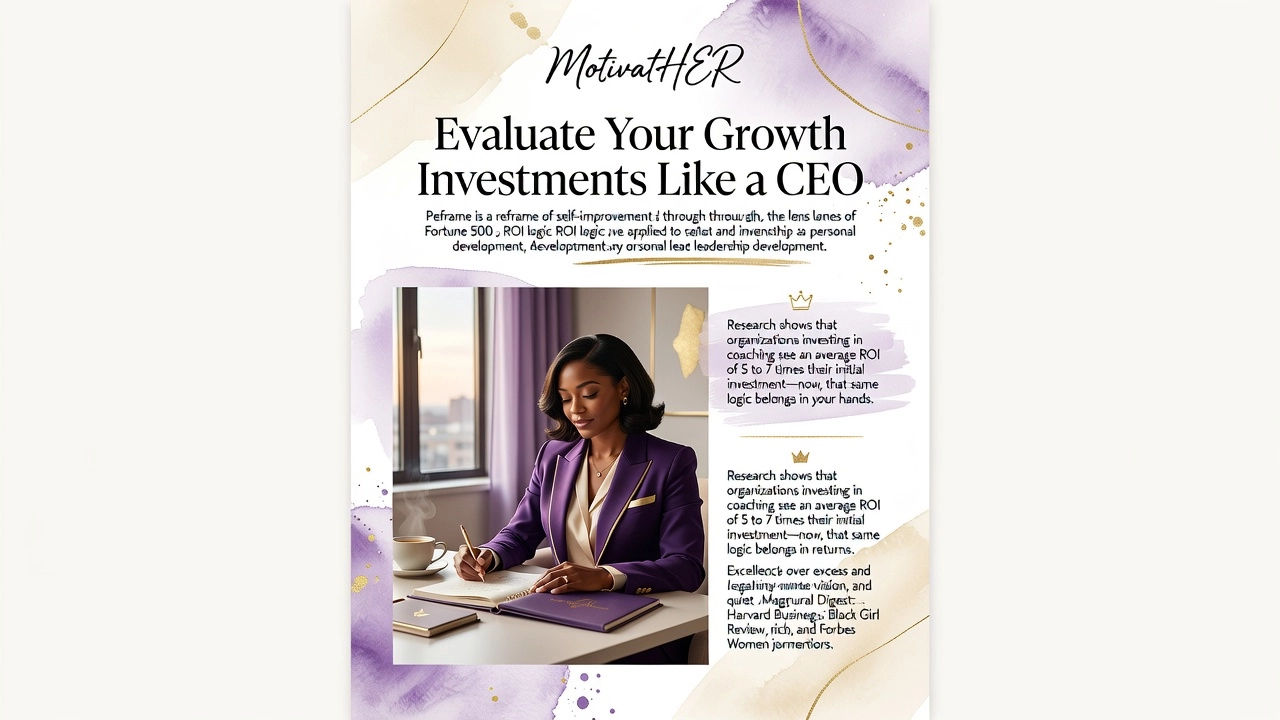
Here is a reframe that the self-improvement world has been slow to offer: the same return-on-investment logic that Fortune 500 companies apply to leadership development belongs in your hands too. Research shows that organizations investing in coaching see an average ROI of 5 to 7 times their initial spend, and 86% of companies that actually measured their results reported recouping their full investment. That data lives at the enterprise level right now, but the underlying logic does not have to. Women investing in personal coaching, e-courses, or leadership programs deserve to approach those decisions with the same strategic clarity a CEO brings to a budget meeting.
Ask the Three CEO Questions Before You Invest
A CEO does not fund an initiative on hope and good intentions. She asks specific questions before committing resources, and you should too. The first question is: what specific outcome am I buying? Not a vague sense of feeling more confident, but a concrete, measurable shift in how you show up, earn, lead, or navigate. The second question is one most people skip entirely: what is the cost of not investing? Stalled career velocity, earnings left on the table, confidence that quietly erodes without reinforcement, and leadership windows that close while you wait for the “right time” all carry real price tags. The third question is about milestones. What does success look like at 90 days? At six months? At one year? Without those markers, growth becomes something you feel in the moment but cannot track over time, and what you cannot track, you cannot compound.
Audit Your Three Growth Investment Categories
Think of your personal development portfolio in three distinct categories. Time is your first investment asset. Where are your learning hours actually going, and is that allocation intentional? Passive consumption of content, scrolling through motivational posts or half-finishing courses, produces passive results. Money is your second category. The question is not simply whether you are spending on development; it is whether your paid investments are aligned with your highest-leverage growth edge right now. A course on a skill you have already mastered is not a growth investment, it is a comfort purchase. Energy is the category most women have never been asked to audit formally. Research on leadership development consistently shows that the strongest predictor of whether learning transfers into real behavior is not program quality; it is the environment surrounding you after the program ends. Which relationships, commitments, and spaces are actively reinforcing your growth, and which ones are quietly draining it?
Where AI Fits and Where It Does Not
AI-powered personalized learning tools are one of the most talked-about development trends heading into 2026, with the market projected to reach $4.5 billion by 2028. These tools are genuinely useful for reducing cost barriers and increasing how customized your learning pathway feels. But they cannot do what a structured coaching relationship does. Content delivery is not identity work. Personalized curriculum is not accountability. The research is consistent on this point: development programs fail most often not because the content was wrong, but because the internal conditions for change were never built in the first place. AI tools work best when they sit alongside relational, identity-driven coaching, filling in the gaps without replacing the human work at the center.
Women who treat self-improvement as a structured investment rather than a passive aspiration consistently outpace those who rely on inspiration alone. Strategy compounds. Intention alone does not. If you are ready to apply this kind of CEO-level thinking to your own growth, MotivatHER’s personal coaching is built for exactly this. The framework connects your individual development to your larger leadership vision, with structured outcomes and real accountability built in from day one.
Your Growth Should Feel Like You
Here is the truth this entire list has been building toward: generic self-improvement advice was not designed with your life in mind. It was not built for the woman navigating a career pivot while raising children, or the one recovering from burnout while still showing up for her team, or the one leading boldly in spaces that were not designed to include her. The most effective growth framework for women integrates identity, not just skills. Your growth should feel like you because it needs to work for you.
So here is where to start. Pick one principle from this list and apply it to your current season, whether that is early motherhood, a leadership transition, or rebuilding after a hard chapter. Not all eight. Just one, practiced with intention.
This week, write your personal growth definition. One paragraph. Start with: “Flourishing looks like this for me right now…” Name it specifically.
Then audit one investment of your time, money, or energy through the CEO lens. Ask yourself: is this energizing me or depleting me? Does it align with who I am becoming? Double down or redirect accordingly.
When you are ready to move from inspiration into real implementation, MotivatHER’s coaching, e-courses, podcast, and email community are built exactly for this moment. This is your next step.

 motivather

 Writer