 Writer
There is something powerful about picking up a book that feels like it was written just for you. Like someone finally put into words everything you have been quietly thinking, feeling, or pushing through on your own.
If you are a woman who leads others, rebuilds herself after setbacks, or simply refuses to play small, the right self help books can feel less like reading and more like finally being understood. They can sharpen your mindset, restore your confidence, and remind you that growth is not a straight line.
But with so many options out there, knowing where to start is the tricky part. That is exactly why we put this list together.
Whether you are brand new to personal development or just looking for your next great read, this roundup has something for you. We are sharing some of the best self help books written for women who are done waiting for permission to take up space. Get ready to dog-ear pages, highlight paragraphs, and walk away feeling genuinely fired up about what comes next.
Why Most Self-Help Book Lists Were Not Written for You
Here is something worth pausing on before you dive into any reading list: women purchase 74% of self-help books in the United States, yet the majority of curated “best of” lists you find online are either gender-neutral or quietly skewed toward male authors writing for male protagonists. That mismatch is not accidental. It is structural. As Goodreads data reveals, women reading self-help books are largely receiving advice written by men, and algorithmic recommendation engines simply reinforce that pattern by rewarding legacy bestsellers built before women dominated the market.
The numbers make this gap even harder to ignore. According to Good e-Reader’s analysis of self-help readership, the self-help genre is one of the fastest-growing nonfiction categories, with U.S. sales reaching $813 million in 2023 alone. Self-published self-help titles on Amazon increased 40% that same year, flooding the market with options. When the shelf is that crowded, trusted curation matters more than ever. A generic algorithm will not tell you which book meets you where you actually are.
Approximately 60% of self-help consumers are women aged 25 to 54, a demographic that is simultaneously navigating ambition, reinvention, leadership, and identity. That is not one challenge. That is four, often happening at the same time. A list built around bestseller rankings cannot account for that kind of complexity.
The 2026 reading landscape is being shaped by themes of sovereignty, identity, and authentic leadership, language that reflects what women are genuinely living through right now. These themes map directly to the work MotivatHER does every day with women who are building lives and careers on their own terms.
That is exactly why this list is organized by life theme rather than chart position. The right book is not necessarily the most popular one. It is the one that speaks to where you are right now.
Books for Women Navigating Identity and Reinvention
If there is one category of self-help books that feels most urgent right now, it is this one. The theme of identity sovereignty, which you can think of as the quiet but firm decision to live as yourself without apologizing for it, is showing up everywhere in 2026 reading circles, coaching conversations, and women’s communities online. It is not a passing trend. It is a response to years of shrinking, performing, and waiting for permission that never came. If you are in a season where the old version of you no longer fits but the new one has not fully arrived yet, these books were written for you.
Each title below includes a MotivatHER Coaching Reflection Prompt so that your reading becomes active, not passive. Because a book can open a door, but you still have to walk through it yourself.
1. You Are the One You’ve Been Waiting For by Richard Schwartz
Richard Schwartz is the creator of Internal Family Systems therapy, one of the most respected frameworks in modern psychology for understanding the many “parts” of who we are. This book brings that lens into something deeply accessible for everyday readers. The core message is that you are not broken, you are fragmented, and the healing is an inside job. For women who have spent years looking to relationships, roles, or achievements to feel whole, this book reframes the entire search.
MotivatHER Reflection Prompt: Which part of you has been doing the most work to keep everyone else comfortable? What would it look like to let her rest?
2. The Source by Dr. Tara Swart
Dr. Tara Swart is a neuroscientist and medical doctor, and this book makes the science of identity change genuinely exciting. She explains how your brain holds onto old beliefs about who you are, and more importantly, how you can rewire those patterns with intention. For the woman who has tried to “think positive” and found it hollow, this book gives you the biology behind why change feels hard and what actually makes it stick. The best self-help books for women in 2026 consistently point toward titles that blend emotional truth with evidence-based insight, and The Source delivers both.
MotivatHER Reflection Prompt: What is one belief about yourself that you inherited rather than chose? How has it been shaping your decisions without your permission?
3. Untamed by Glennon Doyle
This is the book that women keep recommending to other women because it says the thing nobody else says out loud. Untamed is about what happens when a woman stops performing the version of herself that was built to please others and starts listening to the voice she buried a long time ago. It is raw, honest, and at times uncomfortable in the best possible way. Certified clinical psychologist Victoria S. named it one of the top self-help books for women in 2026, and reader communities across social platforms continue to return to it as a touchstone for identity reclamation. If you have ever felt like your life looked right on the outside while something essential felt missing on the inside, this book will feel like being seen.
MotivatHER Reflection Prompt: Where in your life are you currently performing rather than living? What would you do differently if no one was watching?
4. The Big Leap by Gay Hendricks
Gay Hendricks introduces one of the most practically useful concepts in personal development: the upper limit problem. This is the internal ceiling that causes people to self-sabotage just as things start going well. For women navigating ambition and leadership, this pattern can be quietly devastating. You work hard, you get close, and then something in you pulls back. Hendricks argues that this is not weakness; it is a learned response rooted in old stories about how much success, love, or joy you are allowed to have. The 10 must-read self-help books for 2026 list from BookTrib reinforces that books addressing internal blocks are among the most sought-after titles heading into this year.
MotivatHER Reflection Prompt: Think of a moment when things were going well and you found a way to slow them down. What story were you telling yourself about what you deserved?
Ready to Move from Reflection to Action?
Reading is a powerful first step. Research from a 2025 Pew Research Center survey found that 34% of adults who read a mental health or personal development focused book reported feeling better equipped within just three months of starting. But insight without application has a shelf life. If these reflection prompts stirred something in you, that is not an accident. That is the beginning of real work.
MotivatHER’s personal coaching services are designed specifically for women who are done with just thinking about change and are ready to build it. Your identity is not a problem to solve; it is a foundation to claim. And you do not have to figure out the next version of yourself alone.
Books for Women in Leadership or Stepping Into It
Here is a truth that most reading lists will not tell you: you can finish every book on this page and still freeze at the moment that matters most. The promotion conversation. The salary negotiation. The room where everyone else seems to belong and you are quietly calculating whether you do too. That gap between knowing and doing is not a reading problem. It is a practice problem, and it is exactly why research shows that 80% of coached clients report improved self-confidence after working with a coach. Books build the foundation. Coaching builds the muscle. If you are stepping into leadership or preparing to, treat this list as your starting point, not your finish line.
What makes this particular list different from the dozens of leadership reading lists floating around online is that it does not treat identity as a footnote. Your identity is not something to set aside on your way to the top. It is the asset you bring with you. None of the competitor book lists reviewed for this post specifically address the intersection of who you are and how you lead. That intersection is exactly where the most powerful leadership development happens, and it is where these four books live.
1. Dare to Lead by Brené Brown
If you have ever been told that emotions have no place in the workplace, this book is a direct, research-backed response to that idea. Brown’s framework, built from years of studying leaders across industries, argues that courage, vulnerability, and accountability are not soft extras. They are core leadership skills. The Dare to Lead program has taken more than 150,000 leaders across 45 countries through courage-building work, which tells you this is not motivational fluff. It is a structured methodology.
Coaching insight: Brown introduces the concept of “rumble language,” phrases that signal you want to have an honest, open conversation rather than a defensive one. Before your next high-stakes conversation with a manager or a team member, write down exactly how you want to open it using this language. Books give you the vocabulary. A coach gives you the rehearsal space and the real-time feedback to use it without flinching.
2. The Memo by Minda Harts
Most leadership books were not written with women of color in mind, and it shows. Minda Harts wrote The Memo to fill that gap with honesty and practicality. The book addresses how women of color navigate workplaces that were not designed for them, building trust, visibility, and influence without losing themselves in the process. Harts has since released a follow-on title, Talk to Me Nice, which continues her work on how leaders build or break trust through everyday decisions, signaling that her platform and relevance are actively expanding.
Coaching insight: One of the most urgent competencies for women of color in leadership is what you might call strategic visibility, making your contributions legible to decision-makers without code-switching away from your authentic voice. After reading The Memo, identify one project or contribution that is not getting the recognition it deserves. A coach can help you design a specific, low-risk strategy to surface it in a way that feels true to you.
3. Lean In by Sheryl Sandberg
This book remains a starting point for many women exploring ambition and workplace dynamics for the first time, and it is worth reading with clear eyes. Sandberg’s call to stop self-editing ambition has helped a generation of women name what they want. At the same time, the book has faced legitimate criticism for placing too much responsibility on individual women without adequately addressing the systemic barriers that limit advancement. Both things can be true. Read it for the self-audit it invites, and hold the systemic conversation alongside it.
Coaching insight: Lean In is most useful as a mirror. After reading, identify one opportunity you have been talking yourself out of, and write down the specific story you are telling yourself about why you are not ready. Then draft one concrete next action. A coach helps you move from that draft to an actual decision with accountability built in.
4. Lead from the Outside by Stacey Abrams
Abrams wrote this book for women who have been told, directly or indirectly, that they are starting from the wrong place. Her framework reframes outsider identity not as a deficit but as a source of strategic advantage. It is the most intersectional title on this list and the most direct in addressing how women build power from non-traditional starting points.
Coaching insight: Abrams’ approach maps directly to the competency of coalition building. After reading, draw out your existing network and look for the cross-functional or cross-community connections you have that others in your organization may not. That perceived marginality is often a bridge others cannot build. Coaching helps you see it clearly and use it intentionally.
These four books will sharpen your thinking, expand your language, and give you frameworks that hold up in real situations. But reading alone rarely closes the gap between insight and action. MotivatHER’s corporate training and leadership coaching programs are designed specifically to bring the concepts in these books into your actual professional life, so the ideas you underline on a Tuesday night become the moves you make in the boardroom by Friday.
Books for Women Balancing Ambition and Motherhood
Let’s be honest about something first. If you have ever sat at your desk trying to finish a deadline while mentally calculating who is picking up the child, what is for dinner, and whether you remembered to schedule that appointment, you are not disorganized. You are not failing at balance. You are carrying a structural weight that most self-help books have never even tried to address.
This section is for you.
Here is something that matters: not a single 2026 book roundup from any major self-help platform directly addresses the experience of being ambitious and a mother at the same time, as one unified identity rather than two competing roles. Most lists either speak to the career-driven woman or the mom seeking more patience. Almost none speak to the woman who refuses to shrink either part of herself, and who is exhausted not because she is doing it wrong but because the systems around her were never designed with her in mind.
At MotivatHER, we serve women in exactly this season. That is not a marketing claim. It is the reason we can say with confidence: the absence of this mirror in mainstream self-help publishing has a real cost. When the books you reach for do not reflect your specific reality, it is easy to conclude that the tension you feel is a personal flaw rather than a systemic design. It is not. And these three books will help you see that clearly.
Drop the Ball by Tiffany Dufu
This book reframes the entire conversation about ambition and motherhood by challenging the idea that doing more is the measure of a good mother, a good professional, or a good woman. Dufu introduces the concept of dropping the ball not as failure but as a deliberate, courageous act of prioritization. She argues that women have been socialized to believe they must manage everything perfectly, and that releasing this expectation is not giving up but actually the prerequisite for leading well at home and at work. For any woman who has felt guilty about asking for help or delegating, this book is a direct and validating response to that guilt.
I Know How She Does It by Laura Vanderkam
Laura Vanderkam is a time researcher, and this book is built on actual data collected from high-achieving women who are also raising children. What she found, per work-life balance research for working moms, is that these women are not superhuman. They are intentional about priorities and flexible about everything else. Vanderkam includes a time-tracking exercise that breaks your week into 15-minute increments, helping you see where time is actually going versus where you assume it is going. For the beginner reader, this exercise alone is worth picking up the book.
Fair Play by Eve Rodsky
This one will change the way you see your household, and as one working mother writing about essential reads put it, once you encounter these concepts, you cannot go back. Rodsky introduces the idea of the mental load, which is the invisible cognitive labor of tracking, planning, and managing family life that disproportionately falls on women. She reframes domestic life as something that can be structured and shared fairly, not assumed and resented. For ambitious women, this book is not about chores. It is about reclaiming the mental space that ambition actually requires.
If you find yourself somewhere between a career pause and a full sprint, The Power Pause by Neha Ruch is also worth your attention. Published in early 2025, it offers a strategic framework for ambitious women navigating career restructuring as part of a larger life journey, not a departure from ambition.
You deserve books that see the whole picture of who you are.
Books for Black Women and Women of Color
This section of the list is not a token addition. It is not an afterthought tucked at the bottom of a longer list. Black women and women of color have always been among the most intentional, community-driven readers in the self-help space, and that deserves to be named directly and without apology.
The Black Girls Who Read Facebook community is one of the clearest examples of this. A single post asking for self-help and spiritual growth recommendations generated hundreds of reactions and active community conversation, with members including mental health professionals jumping in simply to say they wanted to be part of the list. That is not a niche interest. That is a community of women who already know the value of reading for growth and who trust each other to point them toward the right books. When peer curation happens at that level of engagement, it is functioning as a form of leadership in itself. The women in spaces like that one are not waiting for mainstream publishing to tell them what to read. They are building the list together.
GirlTREK’s Healthy Black Women and Girls community captured something important when they described their reading recommendations as “healing companions,” not just good reads. That framing matters. For many Black women, self-help is not primarily about optimization or productivity hacks. It is about healing what has been dismissed, reclaiming what has been stripped, and building an inner life that the outside world did not always make room for. The books that resonate most deeply in these communities tend to meet that need directly.
Here are four titles worth knowing:
1. Rest Is Resistance by Tricia Hersey Hersey, founder of The Nap Ministry, makes a case that rest is not laziness; it is liberation. In a culture that has historically demanded the most from Black women’s bodies and labor, reclaiming rest becomes a deeply personal and political act. This book has moved beyond the bestseller list into academic and clinical spaces, with researchers and therapists citing its framework as relevant to Black women’s mental and physical health. If you have ever felt guilty for slowing down, this book is a direct challenge to that guilt.
2. All About Love by bell hooks hooks wrote this book as an exploration of love as a framework for how we understand ourselves, our relationships, and the way we move through the world. For women navigating identity, leadership, and community, her arguments about what love actually requires, honesty, accountability, and care rather than control, offer a grounding that most self-help books miss entirely. Her voice is one of the most cited in Black women’s reading communities for good reason.
3. Worthy by Jamie Kern Lima This is a book about believing you are enough when visibility feels dangerous and self-doubt feels more familiar than confidence. Kern Lima writes from her own experience of building something significant while fighting the internal narrative that she did not belong. For any woman who has shrunk herself before someone else could reject her, this book speaks to that pattern directly.
4. The Secret to Success by Eric Thomas Eric Thomas writes and speaks from a place of faith-rooted ambition, and his message has resonated widely among Black women who want to connect their drive to something deeper than achievement alone. This is a book about discipline, purpose, and refusing to let your circumstances define your ceiling.
One trend worth watching in 2025 and 2026 reading conversations is the “Let Them” mindset, which has been circulating in Black women’s book communities as a way of naming the emotional work of releasing control over other people’s choices and saving your energy for your own growth. Whether you encounter it as a formal book or a framework being passed around in group chats and comment sections, it reflects where emotional and relational growth conversations are headed, toward boundaries, self-trust, and the quiet power of redirecting your attention inward.
Women of Color in the Arts encouraged their community in summer 2025 to form small reading groups as a way to practice being in “radical community.” That phrase is worth sitting with. Reading together, sharing what moves you, building a list for someone else before they even ask, that is leadership. And it is already happening.
Audiobooks for Women Who Lead on the Go
Let’s talk about the woman who has not sat down quietly in three weeks. She is answering emails between meetings, coaching her team while mentally drafting a grocery list, and somehow still trying to grow. If that sounds familiar, this section was written for you.
The self-help audiobook category grew 22% year-over-year in 2023, making it one of the fastest-growing formats in publishing. That number is not surprising when you consider who is actually doing the reading. The woman leading between school drop-off and the boardroom deserves a reading list that meets her in the car, on the treadmill, and during the commute, not only at a quiet desk on a Sunday afternoon. Audio makes that possible without sacrificing the quality of the content.
Here are three titles that translate exceptionally well to the listening format:
1. Becoming by Michelle Obama
Michelle Obama narrates this memoir herself, and that choice changes everything. You are not hearing someone read her words. You are hearing her tell you her story, and the difference is felt in every chapter. The emotional weight of her leadership narrative, her reflections on identity, and her honest account of navigating power in spaces not built for her land differently when you hear them in her voice. This is the kind of audiobook you will replay sections of during a long drive, not because you missed something, but because it moved you.
2. You Are a Badass by Jen Sincero
This book was practically written for audio. Jen Sincero’s tone is conversational, sharp, and energizing in a way that reads almost like a pep talk from your most direct friend. The title has sold over 5 million copies and its momentum has not slowed because the message does not feel dated. On audio, the humor lands better, the urgency hits harder, and you will find yourself nodding along on a treadmill more than once. If you need something that meets you with momentum on a hard morning, start here.
3. Think Again by Adam Grant
This one rewards active listening. Adam Grant challenges you to question assumptions you did not even know you were holding, and the format works beautifully during a commute or workout when your mind is already in motion. It is not a passive listen. It will make you pull out your phone to take a voice note at a red light, and that is exactly the point. For the woman stepping further into leadership, this book builds the kind of flexible thinking that makes every other skill on your list more effective.
A note worth making here: print still outsells digital self-help books 3 to 1, which tells you that audio is not replacing deep reading. It is expanding it. Many women in the MotivatHER community do both, and there is no hierarchy between a highlighted paperback on a nightstand and an audiobook playing through earbuds at 6 a.m. They serve different moments, and both are valid tools for growth.
If you are someone who loves learning on audio and finds yourself hungry for more in between book reads, the MotivatHER podcast is built exactly for that space. It functions as an ongoing audio companion, covering the themes of identity, leadership, and reinvention that run through every book on this list. Think of it as the conversation that continues after the final chapter. You can also explore self-improvement audiobook recommendations to build out your listening queue beyond these three titles.
Growth does not wait for a quiet moment. Sometimes it happens at 65 miles per hour, and that is perfectly enough.
How to Actually Use a Self-Help Book (So It Changes More Than Your Shelf)
Here is something that might sting a little: most self-help books do not change your life because you never really used them. You read them. You highlighted passages. You felt genuinely moved in chapter four. And then, three months later, the book is on your shelf and you are living exactly the same way. This is not a willpower problem. It is a method problem.
Research published in Cognitive Behaviour Therapy by scholars from Oxford, UCL, and Curtin University confirms that self-help materials only produce meaningful outcomes when they are implemented with structured support, not simply consumed. The inspiration is real. The integration just never happened.
So here is a three-part framework that actually closes that gap.
1. Read with a specific intention. Before you open the first page, name the one growth edge you are working on right now. Not a vague goal like “be more confident.” Something specific: “I shrink in rooms where I feel unqualified.” Let that be your lens for the entire book.
2. Journal through each chapter using a prompt, not a highlighter. According to clinicians at Open Arms Wellness, writing moves you from being inside an emotion to observing and understanding it, which is the neurological shift that passive reading skips entirely. After each chapter, write your answer to one prompt: Where did I see myself in this? What would have to change for this insight to become a habit?
3. Bring the book into community. Discuss it with a coach, a peer, or a group. Guided self-help consistently outperforms solo self-help in the research literature because accountability and dialogue turn reflection into action.
Millennials spend an average of $500 per year on self-improvement, which means cost is rarely the barrier. Integration is. The book gives you the insight. The ecosystem around it determines whether that insight becomes a behavior change you can actually feel six months from now.
That is exactly what MotivatHER is built to be: the ecosystem. The e-courses, coaching services, and podcast exist to transform your reading list into a lived growth practice, not just a well-curated shelf. If you are ready to move from insight to action, explore personal coaching with MotivatHER and bring your next book to a conversation that actually changes something.
Your Next Chapter Starts With the Right Book and the Right Support
You have covered identity and reinvention, leadership, ambition and motherhood, books for Black women and women of color, and audiobooks for women on the go. Each category exists because different seasons call for different wisdom. The right book for you is not the one sitting at the top of a bestseller chart this week. It is the one that meets you exactly where you are standing right now.
Here is something worth honoring before you close this tab: the fact that you went looking for books that speak to your whole self, your leadership, your identity, your roles, your reinvention, is not a small thing. That search is self-awareness in action. It means you already know that generic motivation is not enough. You are looking for something that sees you. That matters.
Books are a powerful starting point, but they are not the finish line. Real, lasting change happens when reading is paired with coaching, community, and intentional practice. Eighty percent of coached clients report improved self-confidence, and that kind of shift comes from application, not just inspiration.
If you are ready to take what you have read and turn it into real movement, explore MotivatHER’s coaching programs, e-courses, and podcast. Your next chapter deserves more than good intentions and a highlighted page.
Know a woman in her growth season? Send her this list.
Conclusion
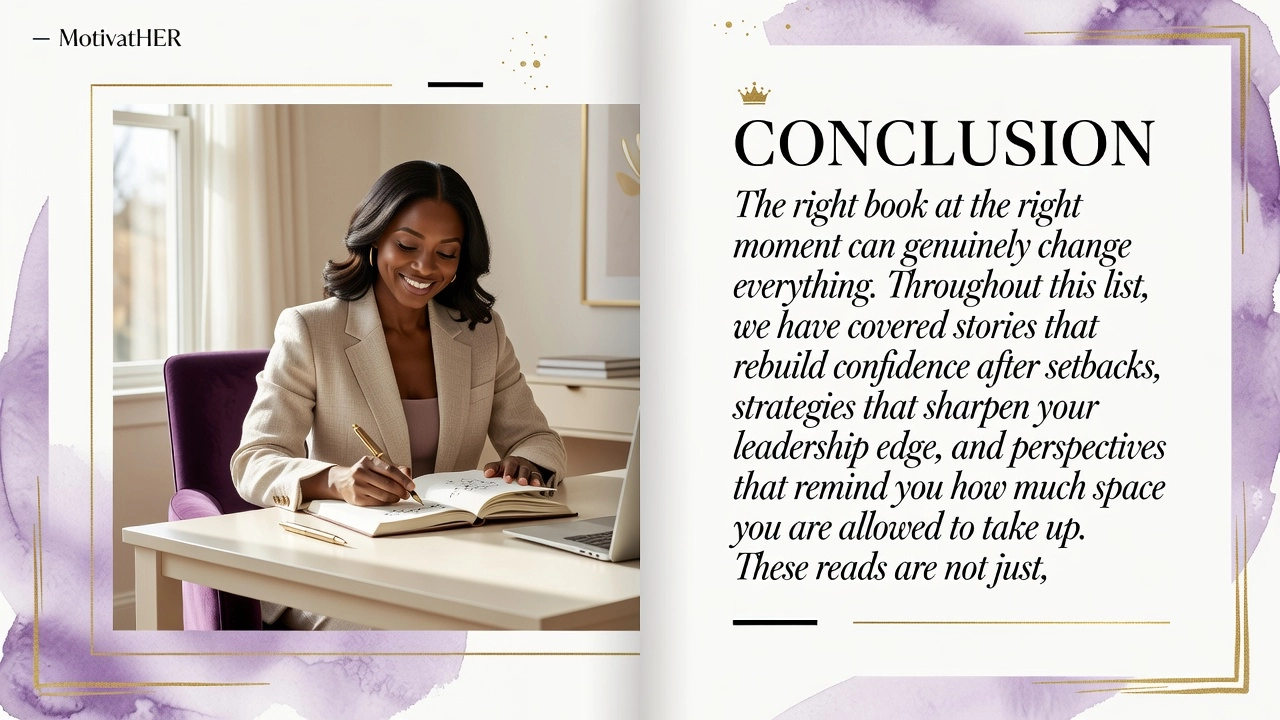
The right book at the right moment can genuinely change everything. Throughout this list, we have covered stories that rebuild confidence after setbacks, strategies that sharpen your leadership edge, and perspectives that remind you how much space you are allowed to take up. These reads are not just pages to flip through; they are tools for women who are actively growing, pivoting, and pushing forward.
Here is your next step: pick one title that spoke to you and order it today. Not next week. Today. Highlight the parts that hit hard, revisit them often, and share your favorites with the women in your circle who need them too.
You do not need permission to invest in yourself. You never did. Now you just have a few more powerful voices in your corner reminding you of that.


 motivather


 Writer